| Home
About Bison
F.A.Q.:
Bison
Grassfed
Humane Animal Husbandry
Pioneering Heroes Links
Recipes
About Us
Products
Our New Book
News/Articles
Heritage Ranch Tour
|
1. What is “100% Grassfed”?
100% Grassfed Bison means the animal has lived from birth to harvest completely on grass. Hay (dried grass) may be given during harsh winter months, as well as mineral supplements which may contain a small amount of wheat. 100% Grassfed animals receive no corn or grain; they never see a grain or corn feedlot/feedyard, which may include hormones, antibiotics and animal byproducts. Feedlot finishing contains a higher likelihood of ecoli, which the commercial industry has begun to address through methods of irradiation.
2. Why is 100% grassfed better than grainfed?
a. For Us. Nutritionally, studies show grassfed and grass-finished meat contains more betacarotine, a natural cancer fighter; more omega 3s, more CLA’s, more natural Vitamin E (rather than vitamin injections or artificial feed supplements). In addition, grassfed bison has less fat and cholesterol than it’s feedlot counterpart.
b. The Animal. A grassfed bison humanely remains on pasture its entire life and forages on a variety of grasses. Grain is unnatural for a ruminant; it is documented that ruminants cannot tolerate the high acid content of grain much more than 60-90 days, at which time the liver begins to fail. Commercial producers know this, but allow that the animal will be harvested anyway, so it doesn’t matter. The liver, which cannot pass inspection, is rejected for human consumption, one of the reasons liver is rarely for sale in supermarkets. The FDA continues to allow feed to contain animal proteins such as bovine blood, feathers, chicken manure, and fish. Some worry that since bovine meat & bone meal is fed to chickens, pigs & fish, this may find its way back to feedlot animals when they eat the protein of animals that have been eating them.
c. The Environment.
(1) While grazing, grassfed Bison renew the pastures and grasslands which stimulates new growth. It does need to be managed based on the amount of land they are on, but compared to feedlots, grazing is earth friendly, sustainable and uses a renewable resource - the Sun!
(2) In contrast, here are a few facts associated with grain/corn feedlots:
(a) feedlots use 1.2 gals of oil/bushel of corn produced.This works out to roughly 284 gal. oil per feedlot beef, or as NY Times writer Michael Pollan puts it, “[feedlots create] another fossil fuel machine!”
(b) nitrogen runoff from corn crops has created a 12,000 sq. mile “dead zone” in the Gulf of Mexico
(c) build up of estrogenic compounds in the environment may explain falling sperm count and early maturation in girls
(d) elevated levels of growth hormones in feedlot wastes eventually wind up in waterways downstream of feedlots, where scientists have found fish exhibiting abnormal sex characteristics.
3. What's the difference between 100% Grassfed and grainfed meat?
a. Flavor. Much like fine wines, grassfed Bison offers subtle flavor variations based on the area where it’s produced. There may be other variations reflecting regional differences in soils and types of grass.
b. Mouthfeel. Many say there is a clarity to grassfed Bison which cannot be found in grainfed meat. Others report they have a film or coating inside their mouth after eating grain or feedlot meat which is absent in grass-finished meat.
c. Sustainability & Costs. Consumer costs may vary, but overall, feedlot production costs are higher while artificially reducing consumer meat prices through government subsidies provided by all of our tax dollars.
(1) Grain/corn. Feedlot feeding relies heavily on the use of oil in chemical, equipment and ferilizer. Four major corporations produce 80% of beef in the U.S. under various brands. Cost for this mass-produced, feedlot meat may appear less at the market but we all pay more in taxes used for crop subsidies, environmental impact and health related issues.
(2) Grassfed Bison uses a renewable resource: the Sun! It takes longer for the animal to naturally reach harvestable weight compared to a fat-laden feedlot animal bulked up with hormones, antibiotics and assorted feedlot elements. While more economical to produce, grassfed bison producers do not enjoy tax subsidies enjoyed by large commercial meat producers, which in turn artificially reduces the consumer price of the meat.
4. Our local store offers ‘grassfed’ meat. How can I be sure this meat is 100% Grassfed?
Only by asking. If the counter person doesn’t know, they can easily find out. They will be proud to tell you if it’s 100% grassfed; it’s hard to find and is in demand by consumers. NOTE: Please keep in mind that such terms as “grassfed,” “free range,” “pasture raised,” and “grass finished”may not be the same as “100% grassfed;” or that the animal received zero corn or grain. Some producers put their animals on corn/grain to bulk them up, then put them back on grass just before harvest. This is not 100% grassfed and will not reflect the superior flavor & nutritional profile when humanely keeping animals on grass their entire lives. The USDA is evaluating the “grassfed” label claim.
We encourage you to ask questions and buy direct from small family producers whenever possible. Read all literature carefully and ask questions until you’re satisfied. These days, it takes an enlightened consumer to navigate these waters and we hope you agree the benefits of 100% Grassfed Bison are well worth it!
Data sources: www.eatwild.com; "Power Steer" by Michael Pollan, New York Times, March 31, 2002.
RECOMMENDED READING: “Everything I Want to do is Illegal”, “Why Grassfed is Best”; “Omnivore’s Dilemma,” “”In Defense of Food,” Fast Food Nation”
©2008-2012 Lindner Bison, all rights reserved.
|
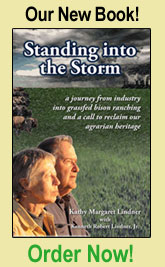
"Standing into the Storm” is a heart story, made astronomically more poignant because it's true. This is the untold story about the integrity food movement -- the sheer passion and persistence required to bring healing food to the culture. Behind the scenes of every integrity food producer is a story of finding heart, not losing heart, filling hearts. Kathy Lindner captures the drama and soul of heritage food like an Indian Chief protecting his village from the Seventh Cavalry. Few people have the privilege of living out such conviction and care. As I read this nurturing story, wiping tears many times, my heart yearned for everyone who cares to immerse themselves in these pages. It speaks to your heart.
- JOEL SALATIN, Polyface Farms,
Swoope, VA

GMO-Free!
|